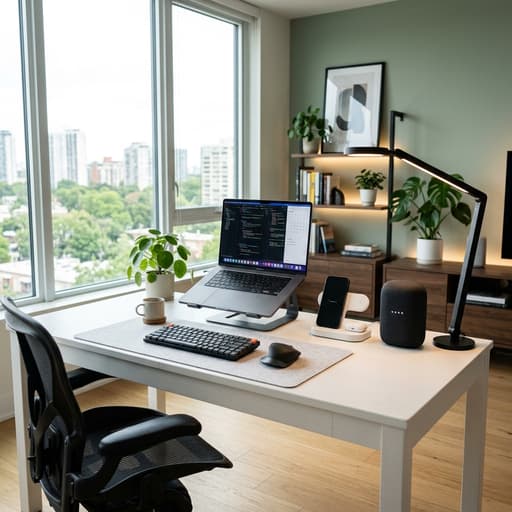
The Future of Home Automation: Beyond Voice Assistants to Intentional Environments
For the past decade, ‘smart home’ technology was defined by the ‘Voice Assistant Era.’ We became accustomed to talking to our speakers, asking for the weather, and commanding our lights to turn on. It was a novelty-driven phase characterized by fragmented systems and ‘connectivity for its own sake.’ However, as we move through 2026, we are entering the era of ‘Intentional Environments.’ This is the transition from ‘reactive technology’ (you tell it what to do) to ‘proactive intelligence’ (it understands what you need). The goal is no longer to have a home full of gadgets, but to have a home that functions as a silent, efficient, and health-optimizing partner.
The Death of the App: The Rise of ‘Invisible’ Interfaces
The biggest frustration of the early smart home was ‘app fatigue.’ Every new lightbulb, lock, and thermostat required its own application, turning our smartphones into cluttered remote controls. In 2026, the ‘app’ is dying. The modern intentional environment is governed by ‘Ambient Computing’-technology that is woven into the fabric of the home. This includes ‘smart surfaces’ (walls and furniture that respond to touch or proximity), ‘gesture control,’ and most importantly, ‘context-aware AI.’ Your home doesn’t need you to pull out a phone to adjust the temperature; it knows you are home, it knows your current metabolic state, and it adjusts the climate accordingly. This ‘Invisible Interface’ is the ultimate expression of luxury: technology that serves you without ever demanding your attention.
1. Bio-Adaptive Lighting: Healing the Circadian Gap
The most significant health contribution of home automation in 2026 is the perfection of ‘Bio-Adaptive Lighting.’ Most modern humans live in a state of ‘Circadian Mismatch’-surrounded by bright, blue-rich light long after the sun has set. This disrupts melatonin production and leads to chronic sleep deprivation and metabolic issues. The intentional environment fixes this at the source.
Using advanced spectrometers, the home’s lighting system now tracks the exact color temperature and intensity of the sun in real-time, mirroring it indoors. In the morning, your bedroom slowly fills with high-intensity blue-green light that naturally suppressed melatonin and boosts cortisol. As the evening approaches, the system automatically shifts to warm, amber tones and lowers the intensity, priming your brain for deep, restorative sleep. This isn’t just ‘smart lighting’; it’s an architectural correction for a biological problem. By aligning your home with the sun, you are biohacking your energy levels and your longevity every single day.

2. The Multi-Sensory Environment: Acoustic and Olfactory Control
Intentional environments in 2026 go beyond light and temperature; they manage all five senses. We are seeing a rise in ‘Integrated Acoustic Management.’ This includes active noise-canceling technology built directly into the walls and windows of urban apartments. The home can identify and ‘neutralize’ city noise-sirens, traffic, construction-while allowing natural sounds like birds or rain to pass through. This creates an ‘Acoustic Sanctuary’ that is essential for mental health and deep focus.
Furthermore, ‘Smart Olfactory Systems’ are now integrated into the HVAC system. These systems use AI to release specific, natural scents (terpenes) throughout the day to influence your mood. Cedarwood and Pinene are released during your work hours to enhance focus and cognitive clarity, while Lavender and Sandalwood are introduced in the evening to lower your heart rate and prepare you for rest. Your home becomes a ‘sensory laboratory’ designed to optimize your psychological state through the invisible power of scent and sound.
3. Predictive Energy Autonomy: The Home as a Micro-Utility
The smart home of 2026 is no longer a drain on the planet; it is a contributor. ‘Energy Autonomy’ is the new standard. Using AI-driven energy management systems, the home predicts your energy needs based on your schedule and the weather forecast. It manages a sophisticated ‘energy stack’ of solar roofing, high-capacity battery storage, and even EV-to-grid integration (using your car as a backup battery).
This is ‘Active Sustainability.’ The home knows when the grid is ‘dirty’ (using coal or gas) and switches to stored renewable energy. It knows when the grid is ‘clean’ and uses that time to charge the house batteries and the car. This level of automation means you can live a high-luxury, high-tech lifestyle with a net-zero (or even net-positive) carbon footprint. It removes the ‘guilt’ from technology and replaces it with a sense of ethical mastery over your environment.
4. Local-First AI: The Return to Digital Privacy
In the past, the price of a ‘smart’ home was your privacy. Data was constantly being sent to the cloud for processing, making homes vulnerable to hacks and corporate surveillance. In 2026, the intentional environment operates on ‘Local-First AI.’ All processing-voice commands, facial recognition for security, and health data analysis-happens on a powerful, local server located within the home itself.
This ‘Edge Computing’ means your data never leaves your four walls. It provides the benefits of advanced AI with the security of a traditional, ‘dumb’ home. This return to digital privacy is a fundamental requirement for the premium market. You cannot feel truly comfortable in a home that you feel is ‘leaking’ your private life to the internet. The intentional environment is a fortress of both physical and digital safety, allowing you to fully relax and be yourself.
Conclusion: The Silent Partner
The future of home automation is not about ‘more tech’; it’s about ‘better tech.’ It’s about creating environments that understand and support the human biological and psychological experience. By removing the friction of daily life and optimizing our health, these systems allow us to focus on what truly matters: our relationships, our work, and our rest. An intentional environment is a silent partner that empowers you to be the best version of yourself. As we move further into 2026, the ‘smart home’ will simply become ‘home’-a place that is as intelligent, resilient, and intentional as we strive to be.